
The Spiritual Beings of Scripture
The Bible describes two separate groups of rebellious angels and gives them opposite outcomes. One group sinned before the Flood and has been imprisoned ever since. The other group follows Satan, is still active, and is not finally judged until the end. This exhibit follows both, in the order the Bible presents them, from the creation of the earth to the last judgment.
- Satan in God's court
- Satan's power on earth
- The fallen angels worshipped as gods
- The angels imprisoned before the Flood
Plates are ordered by when the event happened, not by where the passage sits in the Bible. That is why Jude 6 appears before the Flood and Revelation 12 appears in AD 30. Years follow the chronology used by the globe in Deep Dives, and each plate says how its date was arrived at. Every image depicts the passage it accompanies; every quotation is the World English Bible; and each plate closes with the evidence from outside the Bible.
ISatan in God's court
c. 4174 BCderivedPrimeval
Angels already existed when God made the earth
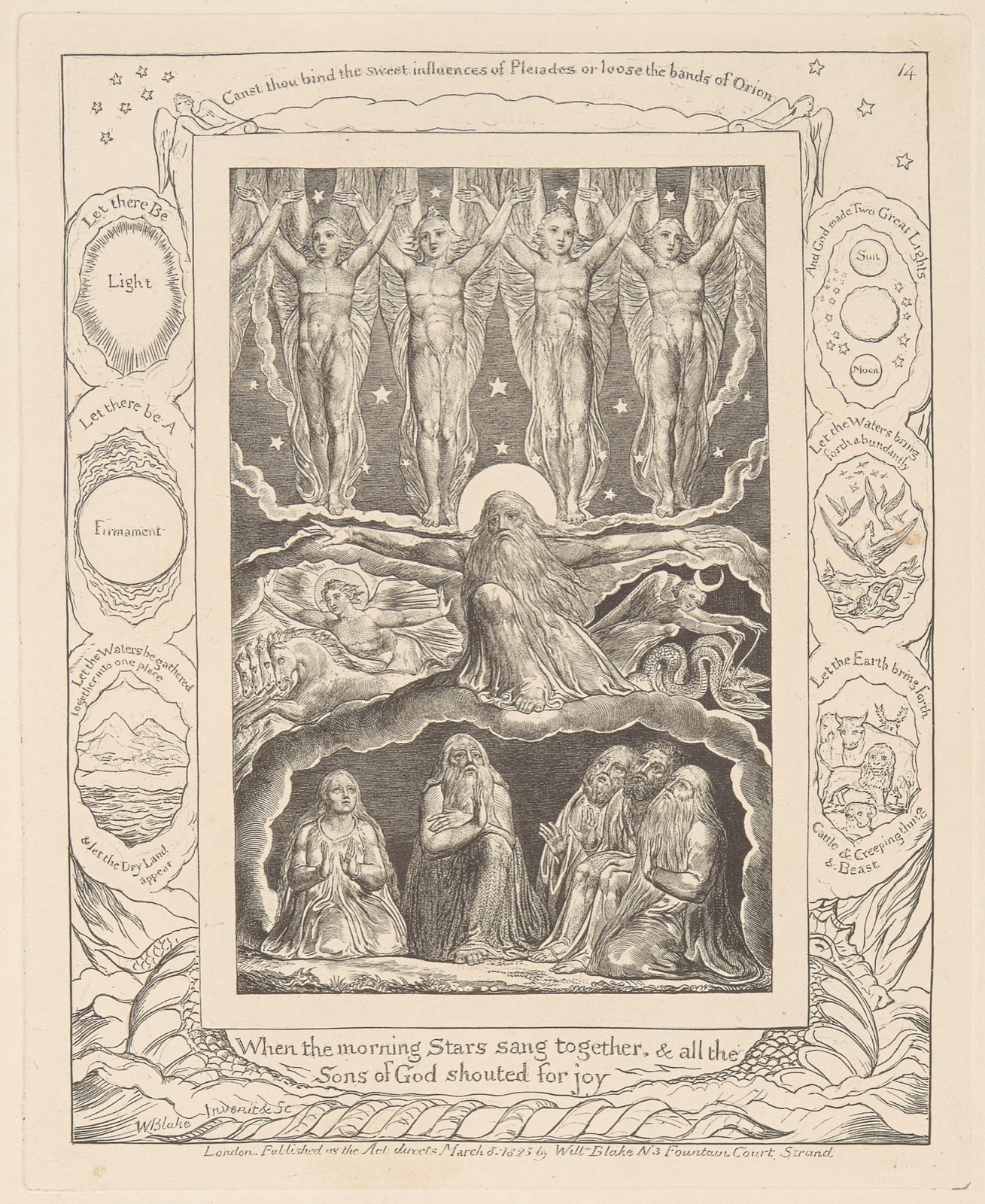
Where were you when I laid the foundations of the earth? … when the morning stars sang together, and all the sons of God shouted for joy?Job 38:4, 7
God is questioning Job, and the question assumes an audience that was already present when the earth was formed. That audience is named in verse 7: the sons of God, a Hebrew phrase the Bible uses for angels. They are described as shouting for joy while the work went on.
Two points follow, and both govern every plate after this one. First, angels are created beings rather than eternal ones. Ezekiel 28:15, addressing the being who became Satan, speaks of "the day that you were created," and Colossians 1:16 lists thrones, dominions, principalities and powers among the things God made. Second, angels existed before human beings did. Every conflict in this exhibit is therefore between a creature and its Creator, never between two equals.
Genesis 1 — the globe’s creation marker.
- angel
- A spiritual being created by God. The underlying Hebrew and Greek words both mean "messenger."
- sons of God
- Hebrew bene ha-elohim. In Job and in Genesis 6 the phrase refers to angels. The World English Bible renders it "God's sons."
Outside the Bible
Mesopotamian texts describe the same order of events, with a divine assembly in place before humanity exists. In the Babylonian creation poem Enuma Elish, written down by about 1200 BC, the gods hold council and only afterward is humankind made — and made specifically to take over labour the lesser gods refuse. Atrahasis, older at around 1700 BC, tells that directly: the Igigi go on strike, and people are created to replace them.
The Weld-Blundell Prism, a four-sided clay prism made at Larsa around 1800 BC and now in the Ashmolean Museum at Oxford, opens with the line "When kingship descended from heaven." It lists eight kings before a great flood with reigns of 28,800 and 36,000 years, marks the flood with a single line — "Then the flood swept over" — and resumes with reigns that shrink toward ordinary human lifespans. Genesis 5 has the same three-part shape: long-lived named figures, a flood, and a continuation on a smaller scale.
When the Morning Stars Sang Together
Blake is illustrating Job 38:7, the verse quoted above.
- Maker
- William Blake
- Origin
- London, England, 1826
- Held by
- Yale Center for British Art
- Licence
- CC0
Made for —
What it shows — God stands at the centre with both arms outstretched, and across the top of the plate four angels sing with their arms raised — the "morning stars" of the verse. Job, his wife and his friends kneel below, beneath a horizon line they cannot cross. Blake divides the sheet so that the singing angels occupy a band the humans have no access to, which is exactly the force of God's question: the angels were there, and Job was not.
IISatan's power on earth
c. 4170 BCundatedPrimeval
God sentences the serpent in Eden and announces its defeat
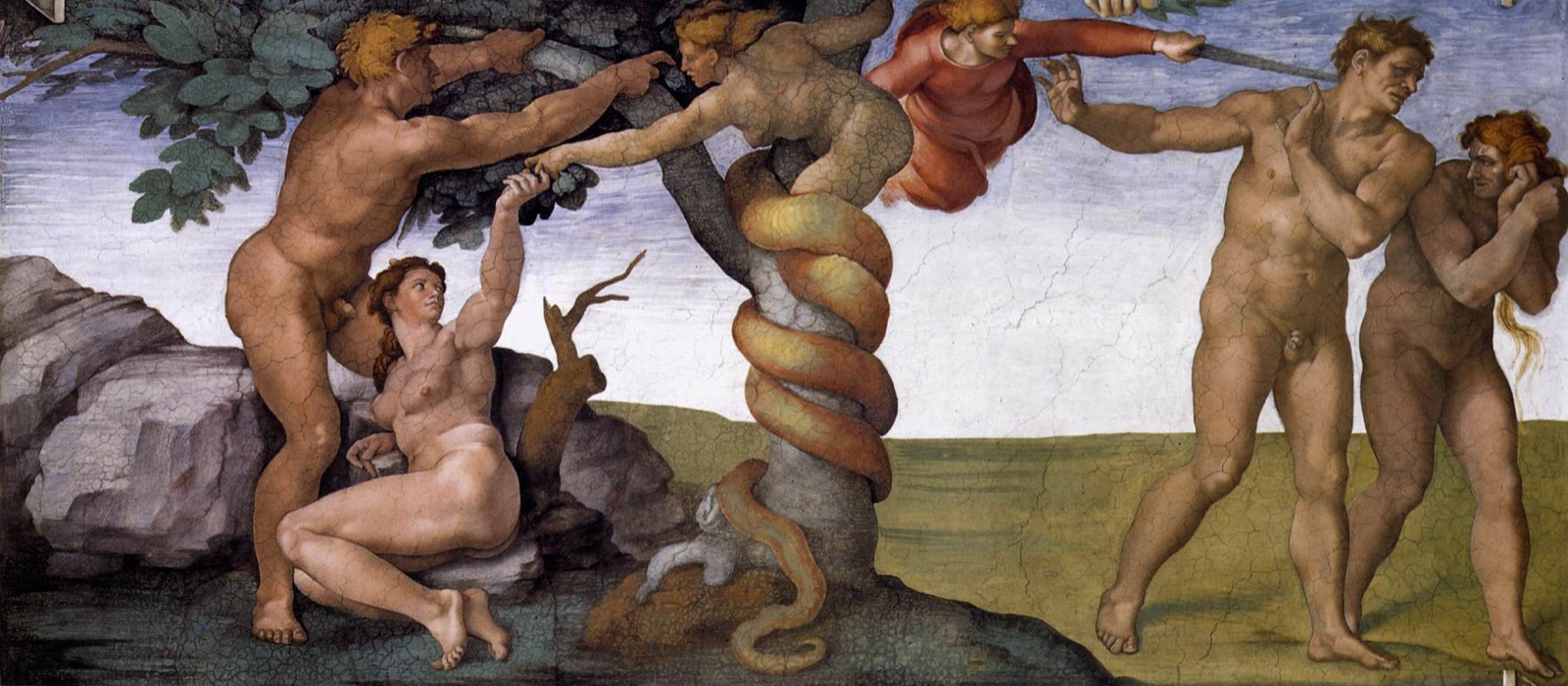
I will put hostility between you and the woman, and between your offspring and her offspring. He will bruise your head, and you will bruise his heel.Genesis 3:15
Genesis 3:15 records the first appearance in the Bible of the being later called Satan. The scene is not a negotiation and not a trial: God pronounces a sentence. The sentence already contains the outcome — a descendant of the woman will crush the serpent's head, while the serpent will only strike his heel. Christian readers from the second century onward have understood this verse as the first promise of Christ's victory.
The Bible never says when Satan rebelled. It gives only a window. At the close of the sixth day, Genesis 1:31 records that everything God had made was "very good." By Genesis 3:1 the serpent is already working against God. The rebellion happened somewhere between those two verses, and the New Testament narrows it no further, saying only that the devil "has been sinning from the beginning" (1 John 3:8).
The globe’s Fall marker. Satan’s own rebellion falls somewhere between this and creation.
- Satan
- From Hebrew ha-satan, "the accuser" or "the adversary." The Bible uses the word both as a job description and as a name.
- the serpent
- Revelation 12:9 identifies "the old serpent" of Eden as "the devil and Satan." That identification is why this plate belongs to Satan's thread.
Outside the Bible
A serpent that deprives a man of eternal life is a fixed feature of Mesopotamian literature. In the Epic of Gilgamesh, Gilgamesh finally obtains the plant that restores youth and a snake steals it while he bathes, then sheds its skin and is gone. In the Adapa myth, the sage of Eridu is offered the bread and water of life and is talked out of accepting them.
The guardians God stations at Eden's gate in Genesis 3:24 have a physical counterpart that survives in quantity. The Assyrian lamassu — a human-headed winged bull or lion, carved in pairs and set on either side of the palace doorways at Nimrud in the ninth century BC — did exactly that job: a composite guardian placed at an entrance to stop what should not pass. Several stand in the Metropolitan Museum of Art, each carved with five legs so the figure reads as standing still from the front and striding from the side.
The Fall and Expulsion from the Garden of Eden
Michelangelo is painting Genesis 3, the chapter quoted above.
- Maker
- Michelangelo Buonarroti
- Origin
- The Sistine Chapel ceiling, Vatican City, 1509–1510
- Held by
- Vatican Museums
- Licence
- Public domain
Made for —
What it shows — One panel holds both halves of the chapter, divided by the tree at its centre. On the left the serpent — given a human torso and a woman's face, coiled around the trunk — reaches the fruit down to Eve. On the right the same two figures are driven out by an angel with a sword, aged and stooped within the width of a single painting. God's sentence in Genesis 3:15 is spoken between those two moments.
IIIThe angels imprisoned before the Flood
c. 2600–2518 BCundatedPrimeval
A different group of angels sinned before the Flood and has been imprisoned ever since
Angels who didn’t keep their first domain, but deserted their own dwelling place, he has kept in everlasting bonds under darkness for the judgment of the great day.Jude 6
The angels described in Jude 6 are the exhibit's second thread, and it is a short one, because the Bible closes it in a single act.
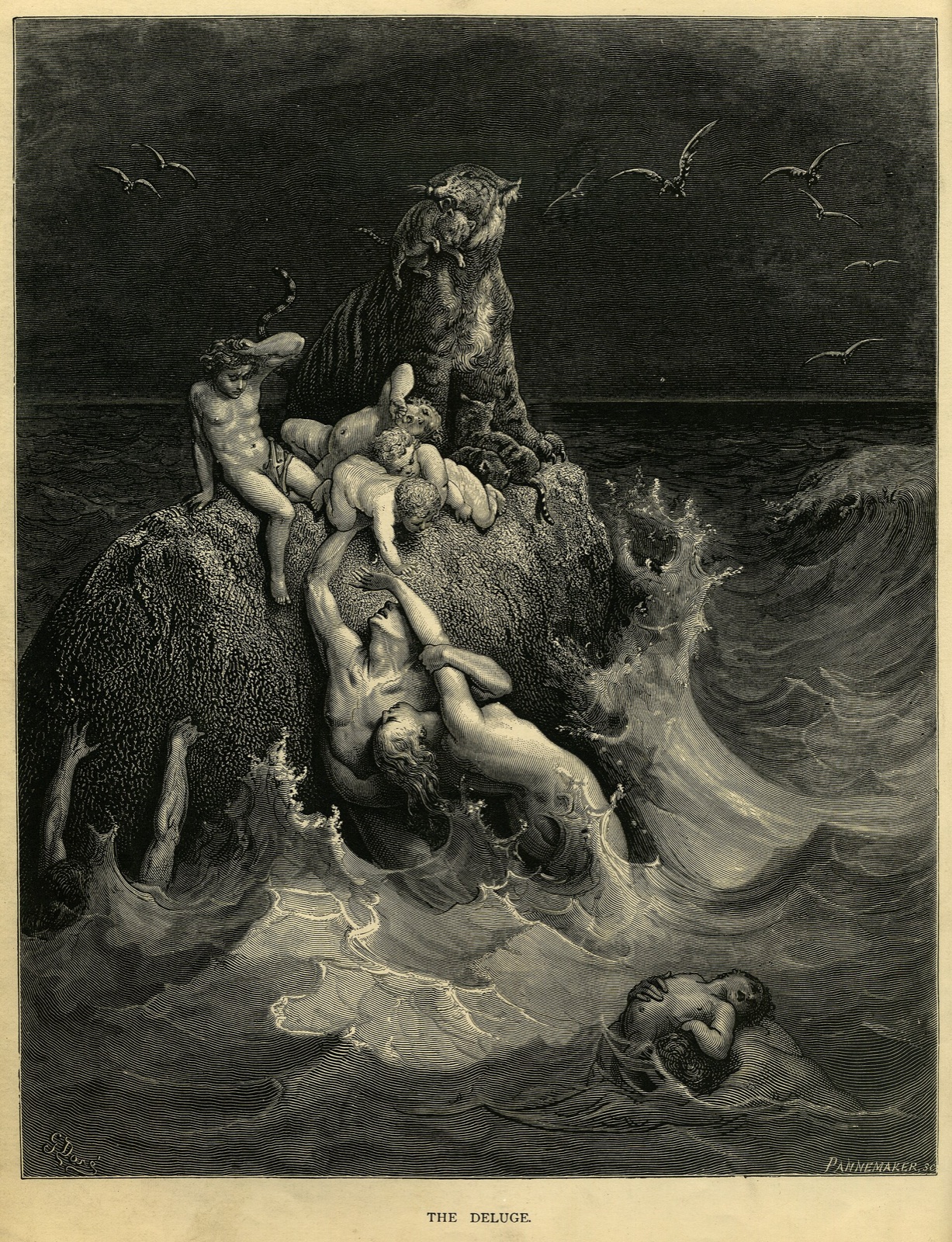
Jude describes angels who abandoned the position assigned to them and left their proper dwelling. God, he says, has kept them in chains, in darkness, awaiting judgment. Second Peter 2:4 describes the same group, says God cast them into Tartarus, and then in the very next verse moves directly to the Flood and to Noah. That adjacency is why this plate carries a picture of the Flood: the two events sit side by side in the text itself. Both passages are traditionally read alongside Genesis 6:1–4, where the sons of God take human wives and the Nephilim appear on the earth.
These angels are kept separate from Satan's angels throughout this exhibit for one reason. The Bible places the two groups in opposite conditions at the present moment: this group is in chains and has been since before the Flood, while Satan, in the same New Testament, "walks around like a roaring lion, seeking whom he may devour" (1 Peter 5:8). Combining them is common in later Christian writing, but the Bible does not state it, and these texts work against it.
From the globe’s “earth filled with violence” marker to its Flood marker.
- Tartarus
- A Greek word for the deepest prison beneath the underworld, where Greek myth confined the defeated Titans. It appears once in the New Testament, at 2 Peter 2:4.
- Nephilim
- A Hebrew word appearing only at Genesis 6:4 and Numbers 13:33, describing beings on the earth before the Flood. The Greek Old Testament translated it "giants."
- Watchers
- The term for these angels in 1 Enoch, and in the Bible only at Daniel 4:13, 17 and 23. 1 Enoch is scripture in the Ethiopian Orthodox canon and in no other.
Outside the Bible
The Flood is the best-attested event in this exhibit outside the Bible. The eleventh tablet of the Epic of Gilgamesh, recovered from the library of Ashurbanipal at Nineveh and now in the British Museum, has Utnapishtim describe surviving it: the god who warned him, the boat built to a given plan, the storm, the birds released one after another, and the sacrifice on the mountain afterward. George Smith read that tablet in 1872, and it was the first proof the account existed outside scripture. Atrahasis, older, tells the same story, and the Sumerian version names the survivor Ziusudra.
What those accounts do not have is Genesis 6's cause. The Mesopotamian gods send the flood because humanity has grown too noisy. Genesis gives a moral reason, and 1 Enoch gives the fullest account of the angels involved: two hundred descending on Mount Hermon, teaching metalwork, weapons, cosmetics, astrology and writing, and being bound underground for it. 1 Enoch survives complete only in Ge'ez, the liturgical language of the Ethiopian Orthodox Church — Greek and Aramaic copies exist only in fragments.
The Deluge
Doré is illustrating the Flood — the judgment 2 Peter 2:4–5 places in the verse immediately after the imprisonment of these angels.
- Maker
- Gustave Doré
- Origin
- France, published 1866
- Held by
- From Doré's illustrations to the Bible
- Licence
- Public domain
Made for —
What it shows — The water has already taken everything. A last outcrop of rock carries a knot of human figures and a tiger, stranded together and no longer fighting each other, while a mother at the waterline lifts two children toward the adults above her. Doré paints no ark and no horizon, only the rock, the bodies and the water, so the picture is entirely about what the judgment removed.
IVThe fallen angels worshipped as gods
c. 2417 BCderivedPrimeval
At Babel the nations are divided, and each is allotted to a spiritual power
When the Most High gave to the nations their inheritance, when he separated the children of men, he set the bounds of the peoples according to the number of the children of Israel. For Yahweh’s portion is his people.Deuteronomy 32:8–9
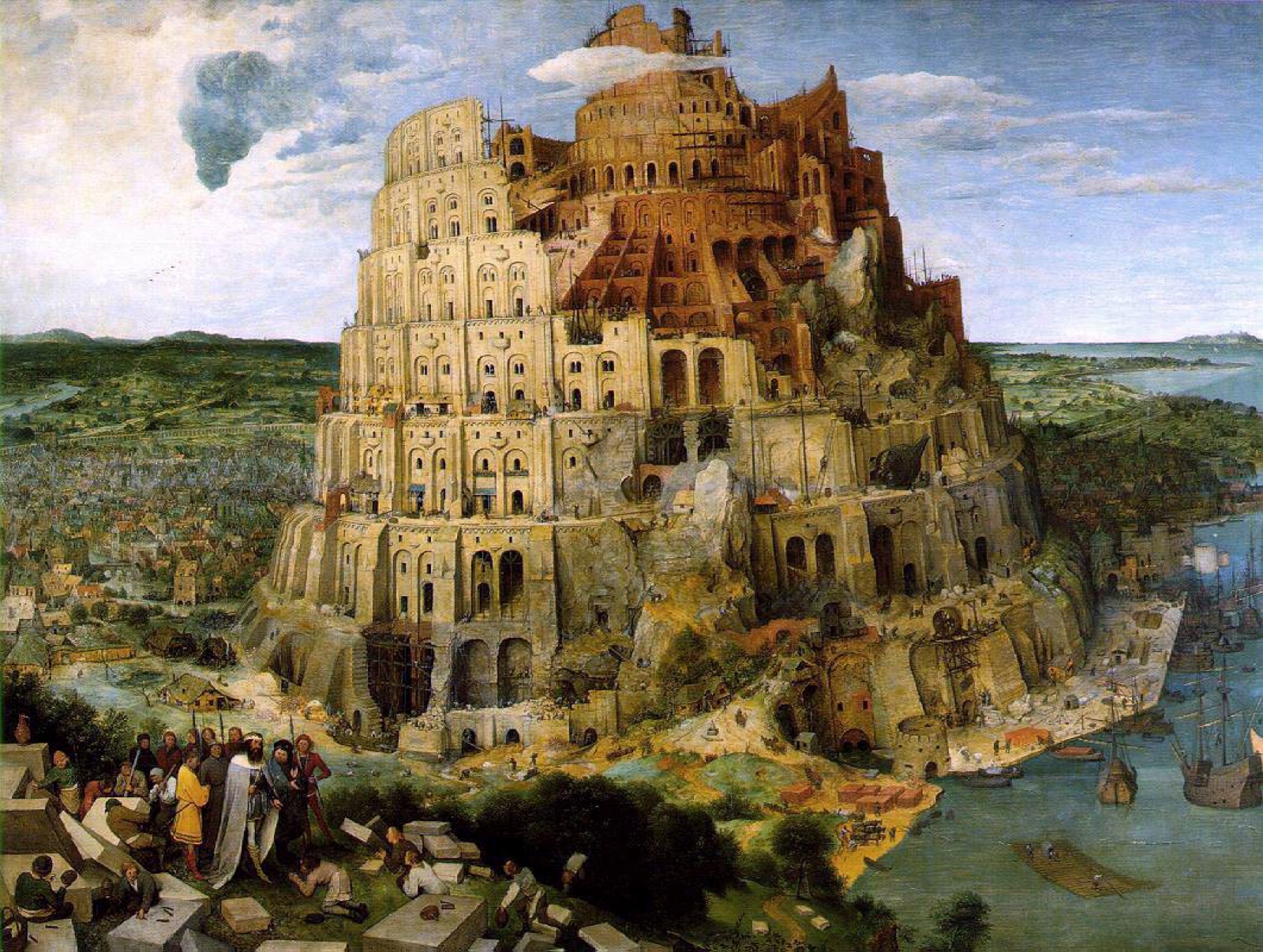
Genesis 11 ends with the languages confused and humanity scattered. Deuteronomy 32 says what happened at the same moment on the other side: as the nations were divided, they were also apportioned. Verse 9 makes the contrast — Yahweh keeps one people directly, and the rest are handed to someone.
Deuteronomy 4:19 names who: God "allotted" the sun, moon and stars, "all the army of the sky," to the peoples under heaven. Daniel 10 shows two of those powers by name and title, a "prince of the kingdom of Persia" who resists an angel for twenty-one days and a "prince of Greece" behind him. Psalm 82 shows God putting those same beings on trial for ruling their nations unjustly, and sentencing them: "you shall die like men."
This plate is the origin point for everything on this thread. Every national religion in the exhibit begins here, at the dispersion — which is why they are contemporaries rather than a sequence.
The globe’s Babel marker, the last event of its Primeval act.
- allotted
- Deuteronomy 4:19 uses a word of formal assignment, the same term used for dividing land among tribes. The nations were not abandoned; they were assigned.
- prince
- In Daniel 10 the word denotes a spiritual ruler set over a nation, not a human king. Michael is called Israel's prince in the same passage.
Outside the Bible
Every civilisation in this exhibit records its own version of the moment its gods took charge of it. The Sumerian King List has kingship descend from heaven onto named cities. Egypt's Turin King List and Manetho both open with dynasties of gods, then demigods, then the spirits of the dead, and only then mortal kings. Mesopotamian and Canaanite treaties were sworn before the gods of each territory as the parties answerable for it.
What the Bible adds is a single origin and a verdict. The nations did not each independently invent their gods; they were divided at one moment and handed over, and Psalm 82 shows those rulers being judged.
The Tower of Babel
Bruegel is painting Genesis 11, the event Deuteronomy 32:8 describes from heaven's side.
- Maker
- Pieter Bruegel the Elder
- Origin
- Antwerp, in what is now Belgium, painted 1563
- Held by
- Kunsthistorisches Museum, Vienna
- Licence
- Public domain
Made for —
What it shows — Bruegel modelled the tower on the Colosseum, which he had drawn in Rome, and the building is already failing before God says anything: the storeys run visibly out of true, the arches on one side do not meet those on the other, and the upper levels are going up while the base is unfinished. Hundreds of workers swarm it at ant-scale, and ordinary Flemish ships ride at anchor below.
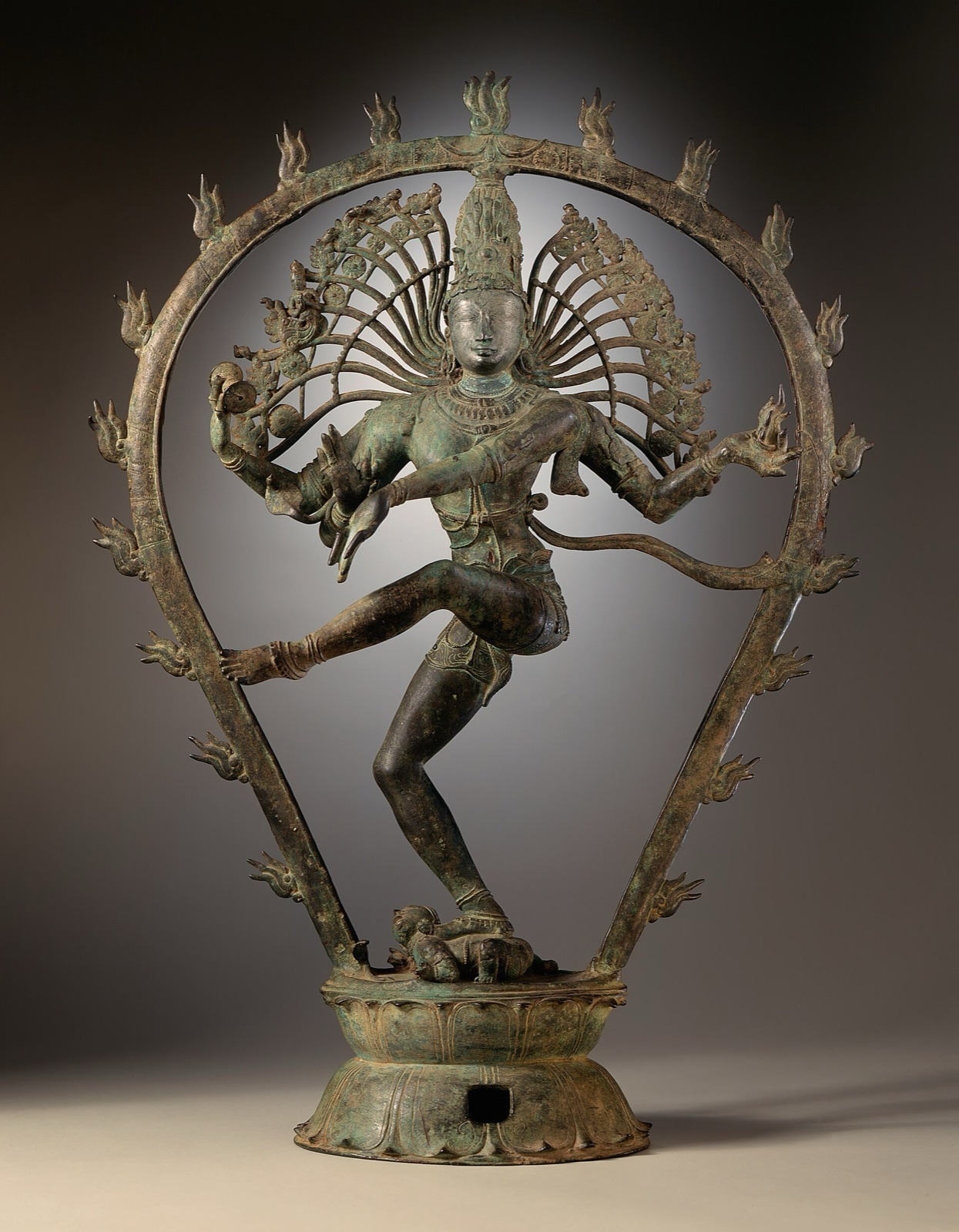
VThe fallen angels worshipped as gods
after c. 2417 BCundatedPatriarchs onward
In India a shining figure descends from the mountain and teaches men to meditate
But I say that the things which the Gentiles sacrifice, they sacrifice to demons, and not to God, and I don’t desire that you would have fellowship with demons.1 Corinthians 10:20
Paul is not saying the gods of the nations are nothing. Two verses earlier he says the idol itself is nothing — and then says the sacrifice reaches something real. The word he uses is demons.
The Hindu tradition tells the origin of yoga in a form the previous plate has already prepared. Shiva is Adiyogi, the first yogi: he comes down from Mount Kailash, and on the bank of a lake he transmits the practice to seven men who wait for him, the Saptarishi, who then carry it to the rest of the world. He is not born into it and he is not taught it. He arrives with it, from a mountain, and hands it down.
Set that beside 1 Enoch 6 and the structure is not similar but identical: two hundred beings descend onto a mountain — Hermon — and give humanity knowledge it did not have, and the knowledge is a real body of skill, taught deliberately, to named recipients.
On this chronology every national religion begins at the dispersion. The surviving Hindu texts are later than the events they record, as are the Mesopotamian and Greek ones.
- Adiyogi
- "The first yogi." The name for Shiva as the origin and first teacher of yoga in Hindu tradition.
- Saptarishi
- The seven sages who receive the transmission from Shiva and disseminate it. Named as a group throughout Hindu literature.
- Kailash
- A mountain in the Tibetan plateau, treated in Hindu tradition as Shiva's dwelling. The descent is from a summit, as at Hermon in 1 Enoch.
Outside the Bible
The descent-and-teaching pattern recurs wherever this exhibit looks. Mesopotamia has the apkallu, seven sages sent by Enki before the Flood to give humanity craft, writing, medicine and kingship, carved by the hundred onto the palace walls at Nimrud. Greece has Prometheus, who brings fire and skill against the will of heaven and is chained to a mountain for it. Egypt credits writing and reckoning to Thoth.
1 Enoch alone treats the transaction as a crime and itemises it: Azazel teaches metalwork, weapons and cosmetics; Baraqijal astrology; Kokabiel the constellations; Penemue writing with ink and paper. Every culture in this room remembers receiving its civilisation from beings who came down. They disagree only about whether to be grateful.
Shiva as the Lord of Dance (Nataraja)
A cult image of the figure this plate concerns, made by his worshippers for worship.
- Maker
- An unnamed Chola bronze-caster
- Origin
- Tamil Nadu, southern India
- Held by
- Los Angeles County Museum of Art
- Licence
- Public domain
Made for —
What it shows — Cast in bronze by the lost-wax method, at the scale intended to be carried in procession. Shiva dances inside a ring of fire, one foot raised and one planted on a small crouching figure, four arms holding a drum and a flame and making the gestures of protection and release. Matted ascetic's hair flies out from the head, and the river Ganges is shown falling through it. The object is not an illustration of a story; it is the thing that received the sacrifice Paul is describing.
VIThe fallen angels worshipped as gods
after c. 2417 BCundatedPatriarchs onward
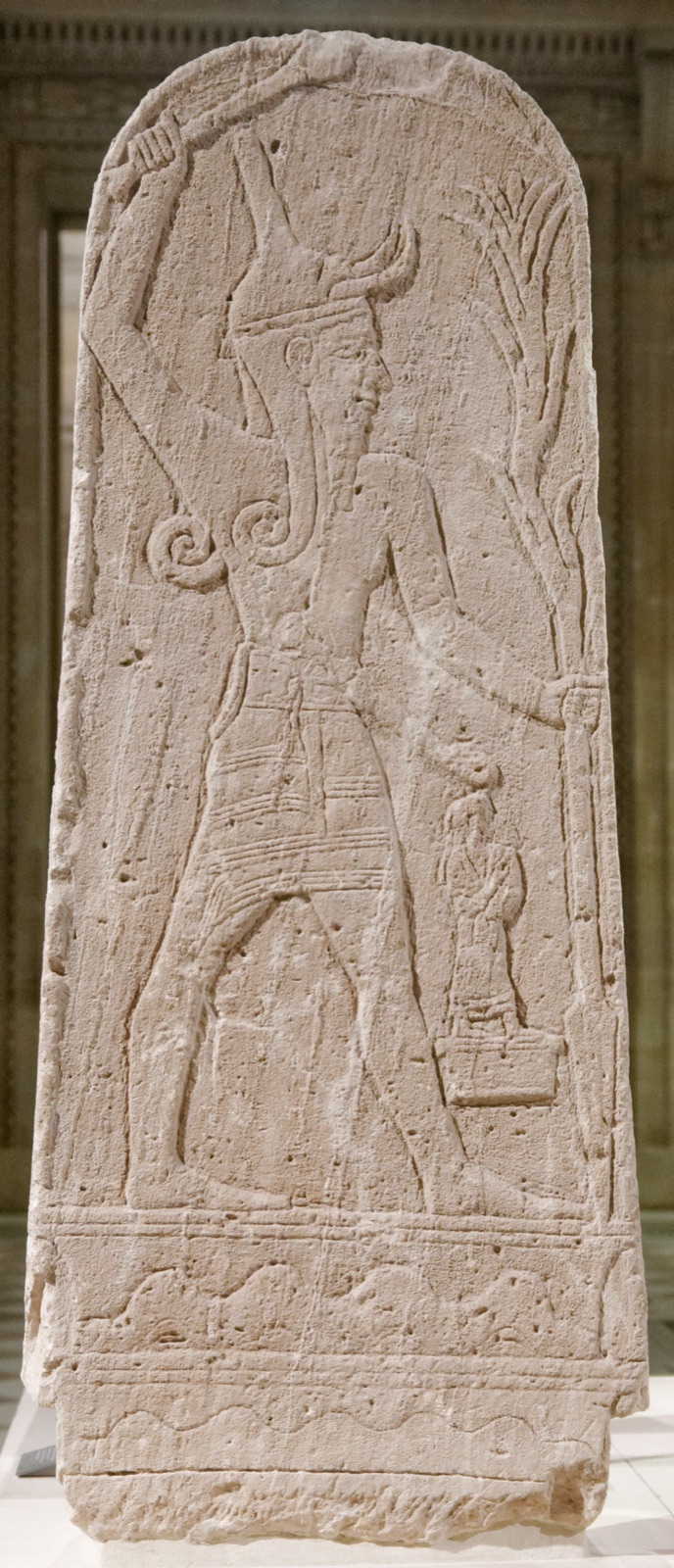
In Canaan a storm god takes the title Lord, and Israel is warned by name
They sacrificed to demons, not God, to gods that they didn’t know, to new gods that came up recently, which your fathers didn’t dread.Deuteronomy 32:17
Baal is the god this exhibit can document most closely, because his own worshippers' library survives. The name is a title rather than a personal name — it means lord, master, owner — and the Old Testament treats his cult as Israel's central and recurring temptation rather than as a foreign curiosity.
Elijah's contest on Mount Carmel, which the globe places at 860 BC, is not a local dispute about religion. It is a test of which being actually answers, staged in front of 450 prophets. One side calls all day and cuts itself and receives nothing. The other answers with fire.
Deuteronomy 32:17 gives the category these belong to, and it is the same word Paul uses in 1 Corinthians 10:20 nearly fifteen hundred years later: demons.
Begins with the dispersion, like every religion on this thread. Israel's direct confrontations with it are datable: Carmel at 860 BC on the globe's scale.
- Baal
- Hebrew and Ugaritic for "lord" or "master." A title applied to the storm god Hadad, and used across the Levant.
- Molech
- The god to whom children were burned, forbidden by name in Leviticus 18:21 and 20:2–5. 2 Kings 23:10 places the site in the valley of Hinnom, outside Jerusalem.
Outside the Bible
The tablets from the same site are the closest non-biblical evidence in this exhibit. Written about the fourteenth century BC in a language closely related to Hebrew, they show the god El presiding over an assembly, the puhru mo'ed, made up of the bn ilm, the "sons of El" — the same construction as the Hebrew bene ha-elohim on plate I.
The Baal Cycle names a sea-monster ltn btn brh, "Lotan the fleeing serpent," and btn 'qltn, "the twisted serpent." Isaiah 27:1 reads "leviathan the fleeing serpent, and leviathan the twisted serpent." The Ugaritic texts also describe the rpum, the deified dead summoned to a feast — the same consonants as the biblical Rephaim, the giant clans of Deuteronomy 2.
The stele of Baal with a thunderbolt
A cult stele of the god Deuteronomy 32:17 and the Elijah narrative are about, excavated from his own city.
- Maker
- An unnamed Ugaritic sculptor
- Origin
- Ugarit, on the coast of what is now Syria
- Held by
- Musée du Louvre, Paris
- Licence
- Public domain
Made for —
What it shows — Limestone, about a metre and a half high, found on the acropolis at Ugarit near the temple. Baal strides forward in a horned helmet, a mace raised over his head in one hand and a spear in the other whose shaft turns into a stylised lightning bolt sprouting vegetation — the storm that brings the harvest. A small figure, probably the king, stands under his protection at knee height. This is the object Israel kept turning back to.
VIIThe fallen angels worshipped as gods
after c. 2417 BCundatedPatriarchs onward
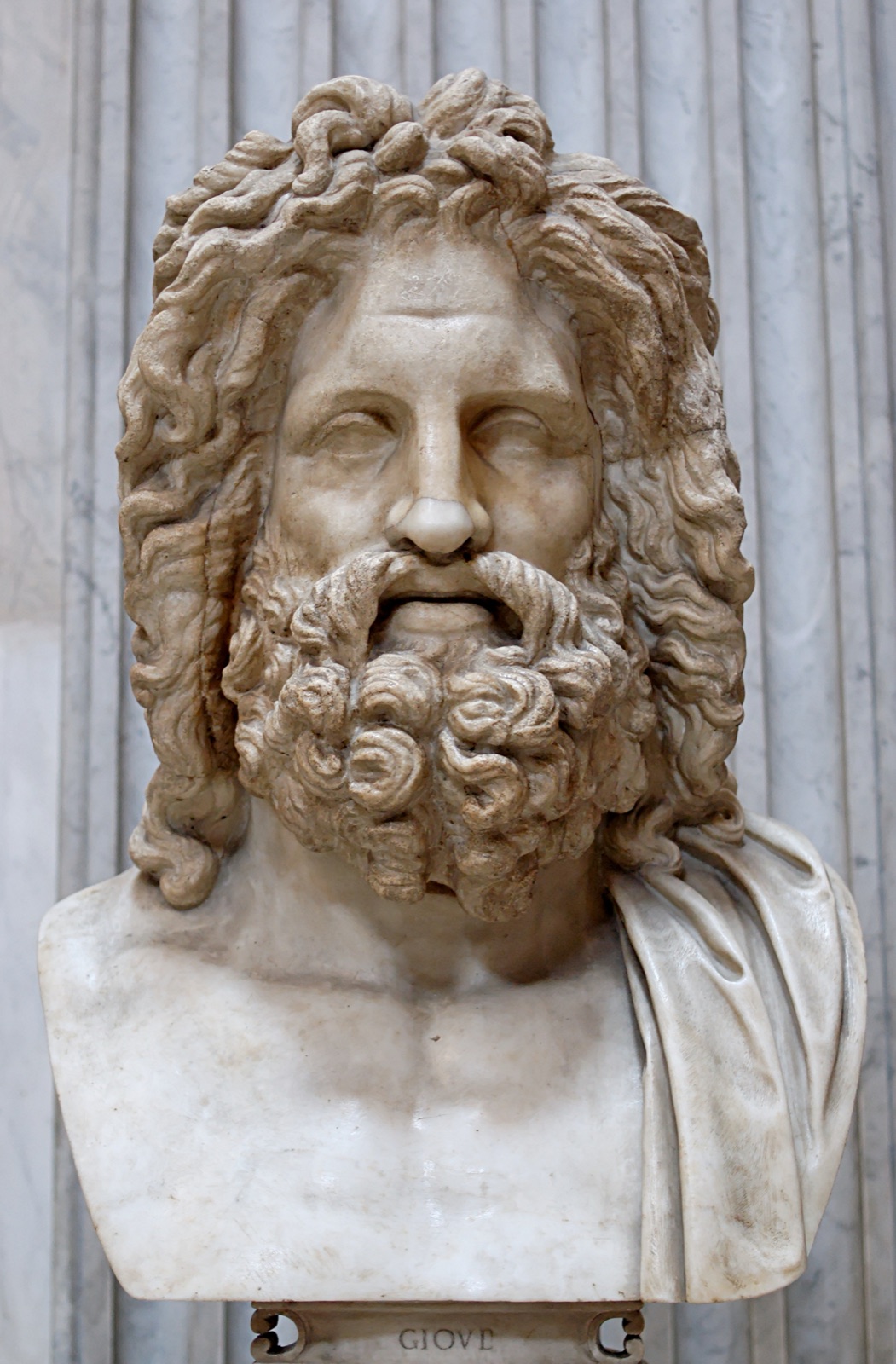
In Greece the gods live on a mountain, take human wives, and father heroes
God presides in the great assembly. He judges among the gods. … I said, “You are gods, all of you are sons of the Most High. Nevertheless you shall die like men, and fall like one of the rulers.”Psalm 82:1, 6–7
Psalm 82 puts the gods of the nations on trial and passes sentence. They are addressed as real beings with real authority, charged with governing unjustly, and told they will die like men.
Greek religion describes the same arrangement from inside it. The gods live on a mountain, hold assembly, quarrel over which peoples and cities they favour, and — the detail that matters most for this exhibit — take human wives and father children by them. Hesiod calls the resulting generation the race of heroes, half-divine, and places it between the bronze race that was destroyed and the iron race that followed.
Genesis 6:4 describes the same category and the Septuagint translators, working in Alexandria in the third century BC, translated the Hebrew Nephilim with the Greek word gigantes — giants. They reached for the vocabulary their own religion already had, because their own religion already had the story.
Begins with the dispersion. Hesiod writes it down around the eighth century BC, describing an age he places long before himself.
- race of heroes
- In Hesiod's Works and Days, the fourth of five ages: demigods born of gods and mortal women, placed between the bronze race's destruction and the present iron age.
- Septuagint
- The Greek translation of the Old Testament, made in Alexandria from the third century BC. Its rendering of nephilim as gigantes shaped every later Western picture of a giant.
Outside the Bible
The Greek material is the most complete non-biblical record of this thread. Hesiod's Theogony has the Olympians overthrow the Titans and shut them in Tartarus behind a bronze gate — and 2 Peter 2:4 uses that Greek name, its only appearance in the New Testament, for where the sinning angels are held. His Works and Days gives the five ages, with a race of demigods destroyed before the present one.
Rome took the same pantheon under other names, Zeus becoming Jupiter. Paul, writing to Corinth in a city full of these temples, does not argue that the gods are imaginary. He says the sacrifices reach demons.
The Zeus of Otricoli
A cult portrait of the chief god of the pantheon Psalm 82 is passing sentence on.
- Maker
- An unnamed Roman sculptor, after a Greek original
- Origin
- Found at Otricoli, Italy; the lost original is Greek
- Held by
- Vatican Museums, Pio-Clementino
- Licence
- Public domain
Made for —
What it shows — A colossal marble head, more than half a metre high, carved so that the hair and beard fall in deep drilled masses catching shadow while the face stays smooth and still. It was made to be looked up at from below. Roman copies like this one preserve a lost Greek original, and the type fixed the image of the supreme god so firmly that later European painting gave the same face to God the Father.
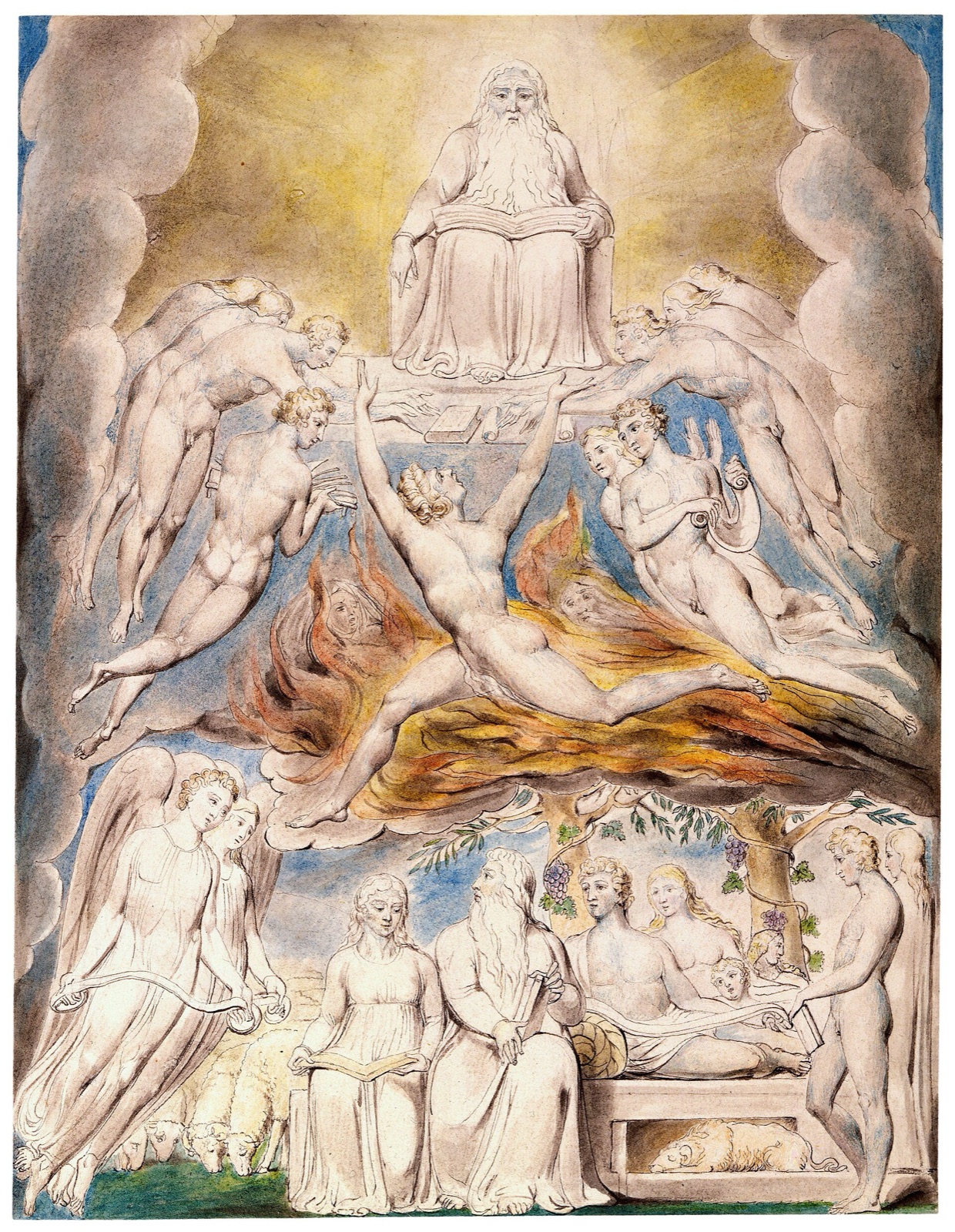
VIIISatan in God's court
c. 2000–520 BCundatedPatriarchs — Exile
Satan appears in God's court and asks permission to test Job
Now on the day when God’s sons came to present themselves before Yahweh, Satan also came among them. Yahweh said to Satan, “Where have you come from?” Then Satan answered Yahweh, and said, “From going back and forth in the earth, and from walking up and down in it.”Job 1:6–7
Long after the events in Eden, Satan is still admitted to God's presence. The passage describes a set occasion on which the angels present themselves before God, and Satan arrives with them. God questions him, and he replies that he has been moving about the earth. He then accuses Job of serving God only for what he gets out of it, and asks permission to strip Job of his possessions. Permission is granted with one restriction: he may touch what Job owns, but not Job himself. In Job 2 he returns, asks for more, and is granted more — with a second restriction: he may not take Job's life.
The Bible shows this same court three more times. In 1 Kings 22:19–22 the prophet Micaiah sees God enthroned with the angels ranged on either side; God asks who will persuade King Ahab into a fatal battle; a spirit volunteers, is questioned on its method, and is authorised. In Zechariah 3:1–2, around 520 BC, Satan stands at the right hand of Israel's high priest to accuse him — the position a prosecutor occupied in an ancient court — and that request is refused outright, the rebuke repeated twice. And in the account of King David's census, 1 Chronicles 21:1 says Satan moved David to number Israel while 2 Samuel 24:1 says God did: one act, credited to both.
Together these passages settle a question readers often raise. Satan was not confined to earth after Eden. He moved between the earth and God's presence, he acted only after asking, and he was answered — sometimes with a limit, sometimes with a refusal.
Job itself is undated. The three other court scenes are datable: the census c. 1000 BC, Micaiah c. 853 BC, Zechariah c. 520 BC.
- present themselves
- The wording describes a formal appearance before a ruler, as a royal court convening on an appointed day.
- divine council
- The assembled angels, pictured as a court around God's throne. Also translated "the army of heaven" (1 Kings 22:19) and "the council of the holy ones" (Psalm 89:7).
Outside the Bible
The divine council Job describes is the standard picture of heaven across the ancient Near East, and the closest parallels are in a Canaanite language closely related to Hebrew. The clay tablets recovered from Ugarit on the Syrian coast, dating to about 1200 BC, describe the god El presiding over an assembly called the puhru mo'ed, the "assembled council," made up of the bn ilm, the "sons of El." That is the same construction as the Hebrew bene ha-elohim on this plate.
The Ugaritic tablets share more than a structure. The Baal Cycle names a sea-monster ltn btn brh, "Lotan the fleeing serpent," and btn 'qltn, "the twisted serpent." Isaiah 27:1 reads "leviathan the fleeing serpent, and leviathan the twisted serpent" — the same pair of epithets for the same creature, in a cognate language, written down by neighbours.
Satan Before the Throne of God
Blake is illustrating Job 1:6, the verse quoted above.
- Maker
- William Blake
- Origin
- London, England, published 1826
- Held by
- From Blake's Illustrations of the Book of Job
- Licence
- Public domain
Made for —
What it shows — God is enthroned at the top of the sheet with an open book, the angels ranged in rows on either side, and Satan stands among them at the centre — upright, inside the frame of heaven rather than beneath it, and addressed directly. Below a dividing line, Job and his family sit at their evening prayers, unaware of the conversation deciding their year. Blake's composition states the passage's own claim: at this stage Satan still has the standing to appear and to be answered.
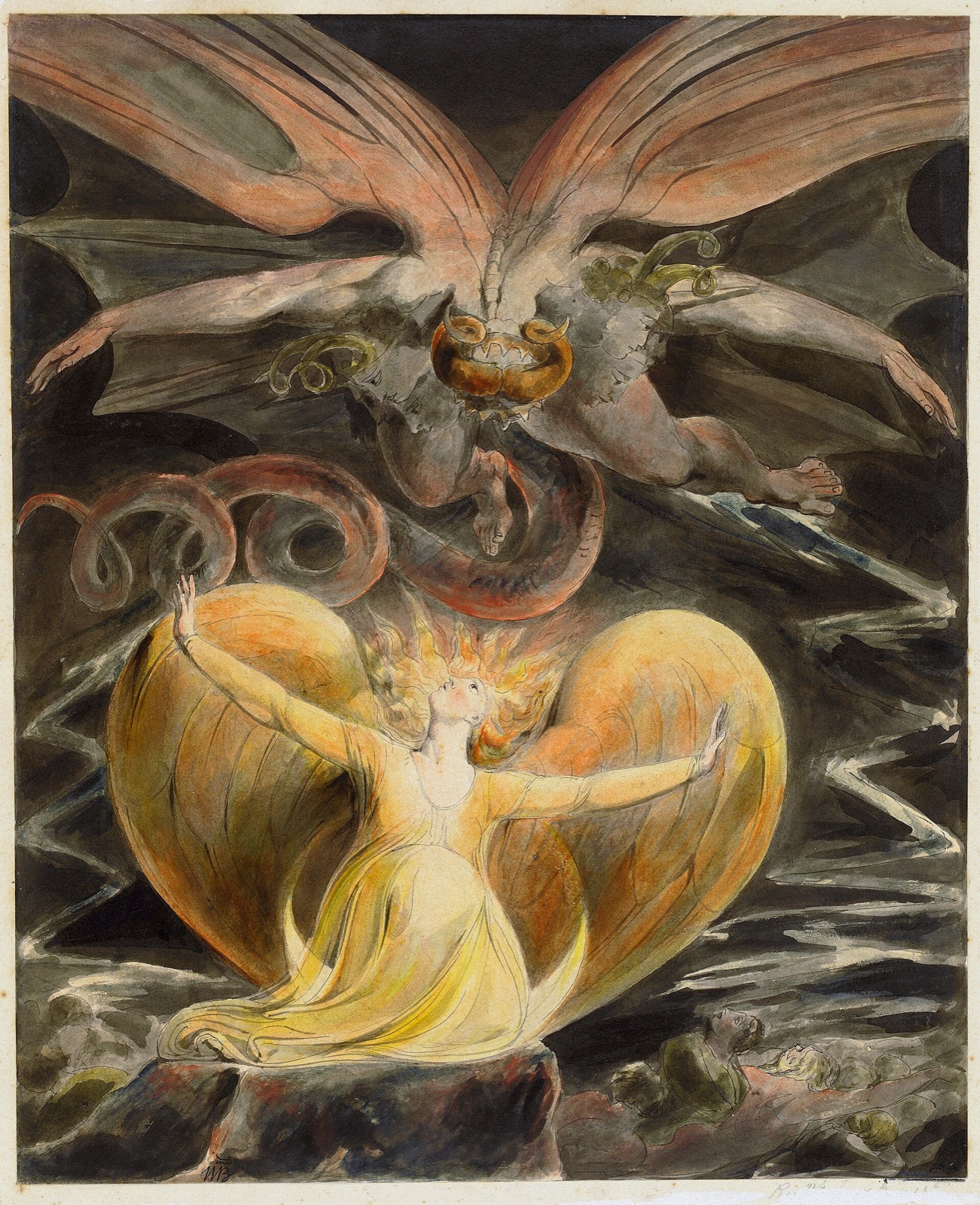
IXSatan in God's court
11 September, 3 BCcontestedChrist & the Church
A sign appears in the sky: a woman clothed with the sun, and a dragon waiting
A great sign was seen in heaven: a woman clothed with the sun, and the moon under her feet, and on her head a crown of twelve stars. … And another sign was seen in heaven. Behold, a great red dragon … His tail drew one third of the stars of the sky, and threw them to the earth.Revelation 12:1–4
Revelation 12 does not describe one moment. It opens with a sign in the sky, moves to a child being born and caught up to God, and only then reports a war. Those are separated in time, and this exhibit separates them: the sign here, the war on plate XII.
The sign is the one item in the chapter that can be checked against the sky. The woman is the constellation Virgo, the sun clothes her when it passes through her figure, and the moon is beneath her feet for the short interval each year when a new moon sets in that position. Ernest L. Martin ran the calculation and found a single window: the evening of 11 September, 3 BC, from about 6:15 when the sun set to about 7:45 when the moon set. He argued that this dates the birth, and the chapter agrees with him about what the sign accompanies — verse 2 has the woman in labour.
What cannot be dated the same way is the dragon. Readers have proposed Draco, Hydra, Serpens and combinations of them, and read "a third of the stars" as Hydra's share of the sky or as a meteor storm. Those proposals do not agree with each other and none produces a date. The woman does.
Ernest L. Martin's calculation of the Virgo configuration, in The Star That Astonished the World. Note that it does not match the globe, which places the nativity at 5 BC — a two-year disagreement this exhibit does not resolve.
- Virgo
- The constellation the woman is identified with. The sun passes through it each year in late summer; the described configuration also needs the moon at her feet, which narrows it to hours.
- contested
- This exhibit's dating word for an event whose position readers genuinely dispute, as against one that is merely imprecise.
Outside the Bible
Reading the sky for signs was the shared science of every culture in this exhibit, and the Bible treats the practice as real without approving it. Babylonian celestial omen series such as Enuma Anu Enlil ran to seventy tablets of observations tied to political outcomes, and Mesopotamian kings kept astronomers on staff to report them.
1 Enoch 8 names the teaching of astrology among the Watchers' crimes, assigning it to Baraqijal and the reading of the constellations to Kokabiel. Deuteronomy 4:19 warns Israel against worshipping the host of the sky that God allotted to the other nations. Matthew 2 then has magi — Persian or Babylonian astronomers — arriving in Jerusalem because they had read something in the sky and travelled a very long way on it.
The Great Red Dragon and the Woman Clothed with the Sun
Blake is illustrating Revelation 12:1–4, the passage quoted above.
- Maker
- William Blake
- Origin
- London, England, painted between 1805 and 1810
- Held by
- Public domain reproduction
- Licence
- Public domain
Made for —
What it shows — Blake turns the dragon away from the viewer and gives it a muscular human back, so that you stand behind it and look with it toward the woman below — she lies in the sun's disc with the crescent moon at her feet, exactly as the verse describes. The dragon's wings and tail fill the upper two-thirds of the sheet. The scale of one figure against the other is the whole statement of the picture.
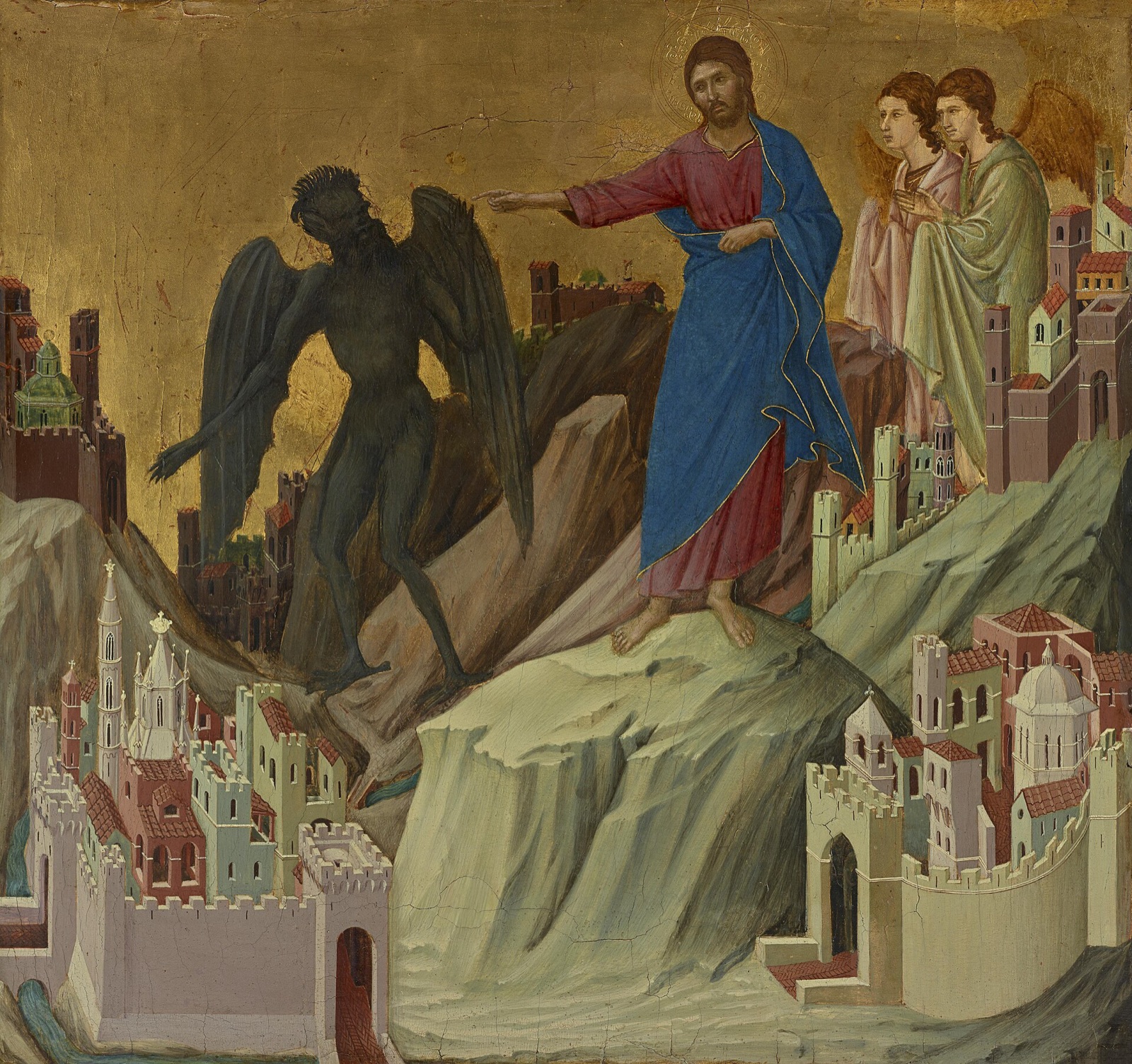
XSatan's power on earth
c. AD 27reckonedChrist & the Church
Satan offers Jesus every kingdom on earth, and Jesus does not deny they are his to offer
Again, the devil took him to an exceedingly high mountain, and showed him all the kingdoms of the world, and their glory. He said to him, “I will give you all of these things, if you will fall down and worship me.”Matthew 4:8–9
The devil takes Jesus to a high mountain, shows him every kingdom on earth, and offers all of them in exchange for worship. Jesus refuses — but note the grounds on which he refuses. He answers that worship belongs to God alone. He does not dispute that the kingdoms are Satan's to give.
Elsewhere the New Testament lets the same claim stand. Paul calls Satan "the god of this world" (2 Corinthians 4:4) and "the prince of the power of the air" (Ephesians 2:2), and John writes that "the whole world lies in the power of the evil one" (1 John 5:19).
This passage is where the two halves of the exhibit meet. What Satan does inside God's court is one line of the story. What he does with power on earth is the other. Here both are visible in a single exchange.
Counted from the globe’s nativity marker at 5 BC.
- the devil
- From Greek diabolos, "slanderer" or "false accuser." The New Testament uses it interchangeably with Satan.
Outside the Bible
Outside the Bible, the claim that spiritual powers hold the nations is ordinary rather than exceptional. Mesopotamian and Canaanite religion assigned each city and each people its own god, and international treaties were sworn before those gods as the parties answerable for the territory.
The Bible describes the same arrangement from the outside. Deuteronomy 32:8 says the Most High fixed the boundaries of the peoples when he divided humanity, and Deuteronomy 4:19 says God "allotted" the sun, moon and stars — the host of heaven — "to all the peoples under the whole sky." Daniel 10 then names two such rulers directly: a "prince of the kingdom of Persia" who resists an angel for twenty-one days, and a "prince of Greece" who follows him. Psalm 82 shows God judging those beings for ruling unjustly.
The Temptation on the Mount
Duccio is illustrating Matthew 4:8–9, the verses quoted above.
- Maker
- Duccio di Buoninsegna
- Origin
- Siena, Italy, completed 1311
- Held by
- The Frick Collection, New York
- Licence
- Public domain
Made for —
What it shows — Christ stands on the mountain with his hand raised in refusal and two angels waiting behind him. The devil, black-winged and gaunt, gestures toward the offer and is already turning to leave. The kingdoms of the world are painted as a handful of small walled towns clustered at the mountain's foot — everything on earth, offered, and rendered small enough to take in at a glance.
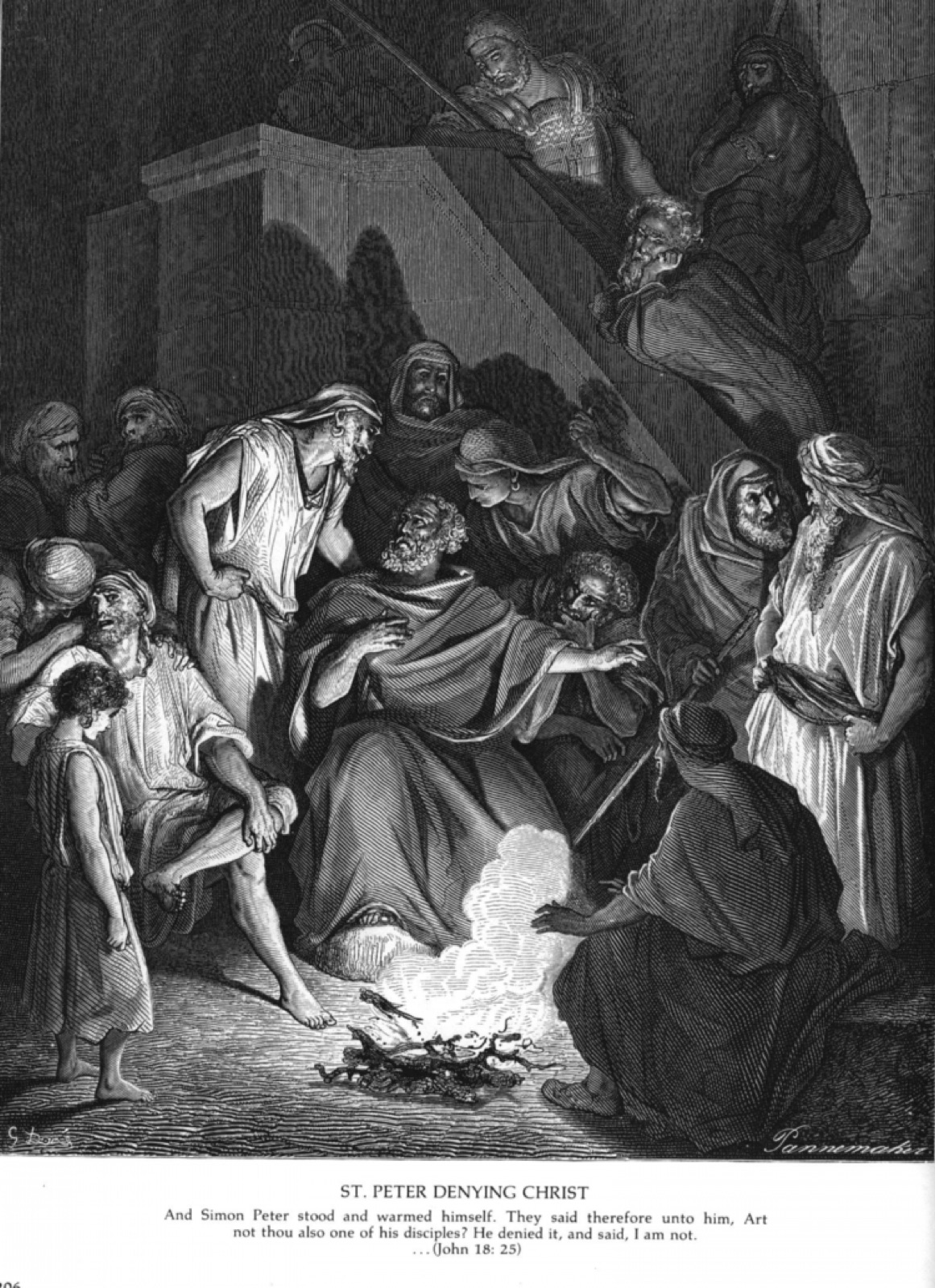
XISatan in God's court
AD 30reckonedChrist & the Church
Satan asks for Peter by name, and Jesus prays against the request
Simon, Simon, behold, Satan asked to have all of you, that he might sift you as wheat, but I prayed for you, that your faith wouldn’t fail.Luke 22:31–32
Jesus tells Simon Peter that Satan has asked to have him and the other disciples, in order to sift them as a farmer sifts wheat. The Greek verb behind "asked to have" is a formal one: to demand something by request, as a claim.
Jesus does not say the request was refused. He says that he prayed for Peter — that Peter's faith would not fail — and then tells him what to do afterward, which assumes the sifting will in fact take place. Within hours Peter denies knowing Jesus three times, and after the resurrection he is restored.
This is the last request the Bible records Satan making. On the next plate, the standing that allowed him to make such requests is taken away.
The night before the crucifixion, the same year as the globe’s Pentecost marker.
- sift as wheat
- Shaking harvested grain so the chaff separates and falls away. The image is of violent testing that leaves only what is solid.
Outside the Bible
The accusing role Satan holds in these passages has a counterpart in Persian court administration, which the Hebrew title ha-satan reflects. Under the Achaemenid empire, travelling officials known as "the king's eyes" toured the provinces and reported disloyalty back to the throne: a roving prosecutor answerable to the king. That is precisely the picture in Job 1:7, where Satan reports having come "from going back and forth in the earth."
The wider Mesopotamian world assumed hostile spirits without ever explaining where they came from. Amulets bearing the head of Pazuzu, a wind demon, were worn and hung in houses to drive off Lamashtu, who was believed to kill women in childbirth and infants in the cradle; several survive in the Metropolitan Museum of Art. That religion supplied the countermeasure and never asked the origin question. The text that answers it is 1 Enoch 15, which is scripture in the Ethiopian Orthodox canon and in no other.
St Peter Denying Christ
Doré is illustrating the sifting Jesus predicts in the verses quoted above, at the hour it happened.
- Maker
- Gustave Doré
- Origin
- France, published 1866
- Held by
- From Doré's illustrations to the Bible
- Licence
- Public domain
Made for —
What it shows — Peter stands in the high priest's courtyard among servants and soldiers gathered around a fire, one hand raised as he denies knowing Jesus. Doré puts Christ in the background, bound and being led away but turned toward him, so the denial and its subject occupy the same frame — and Peter is looking anywhere but at him.
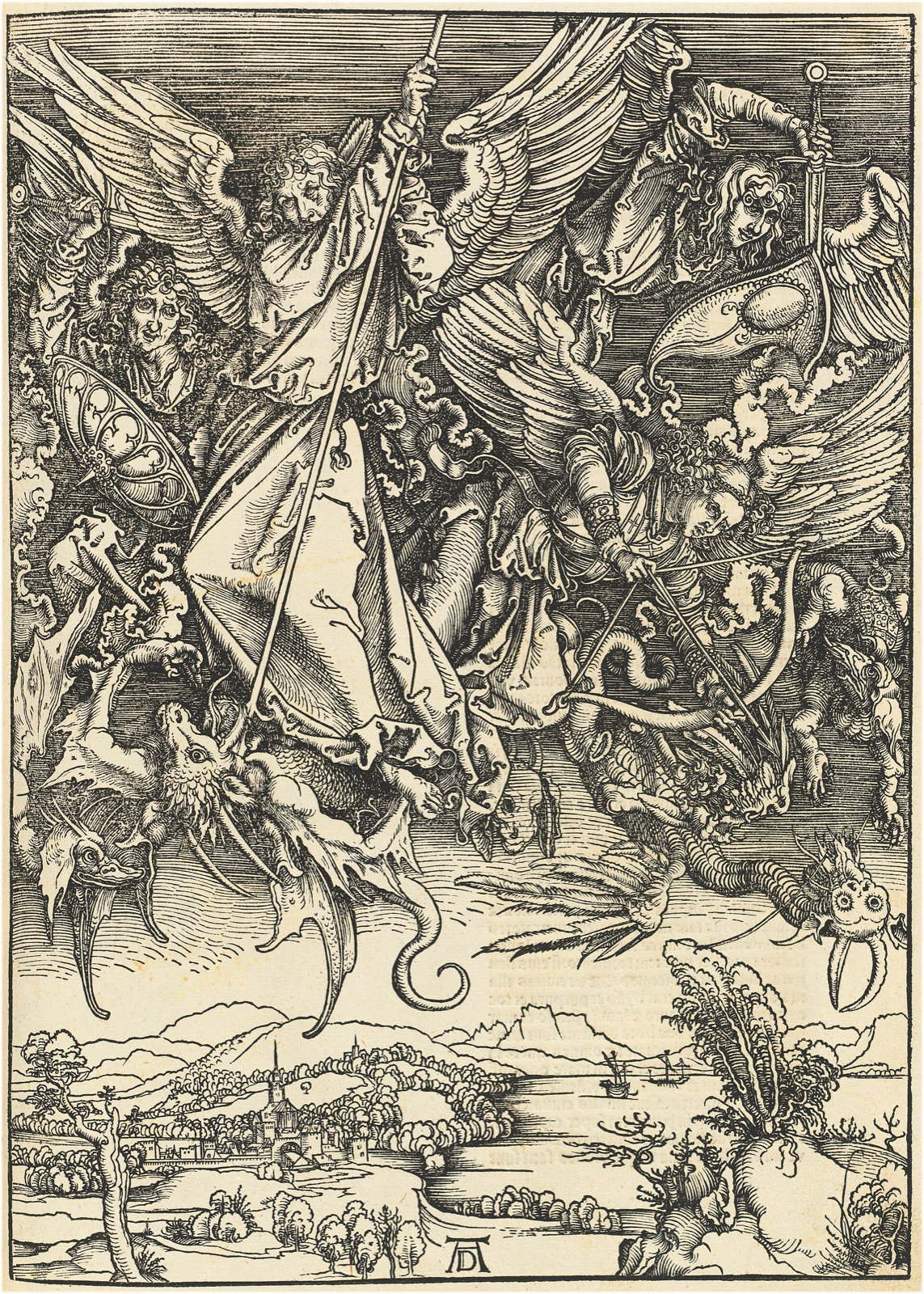
XIISatan in God's court
AD 30contestedChrist & the Church
Satan loses his access to God's court
The great dragon was thrown down, the old serpent, he who is called the devil and Satan, the deceiver of the whole world. He was thrown down to the earth, and his angels were thrown down with him. … the accuser of our brothers has been thrown down, who accuses them before our God day and night.Revelation 12:9–10
Revelation describes a war in heaven. The angel Michael and the angels with him fight a dragon, the dragon loses, and "no place was found for them any more in heaven." A voice from heaven then names precisely what has ended: "the accuser of our brothers has been thrown down, who accuses them before our God day and night."
The activity being ended is the accusing — the same activity seen in Job 1 and Zechariah 3 on plate VIII. This is therefore not the moment Satan became evil, which happened long before Genesis 3. It is the moment he lost the standing to prosecute.
When this occurs is debated among readers. The sign that opens this chapter is on plate IX, and it is datable. The war is not. In the order of the vision itself it follows the male child being "caught up to God" in verse 5, which many take to be the ascension of Christ, and that is why it sits here rather than beside the sign. Jesus said near the end of his ministry, "Now the prince of this world will be cast out" (John 12:31).
Placed at the ascension because the vision's own order puts the war after the child is caught up. The sign that opens the same chapter is separated out to plate IX, where it can be dated astronomically.
- Michael
- An archangel, named in Daniel 10 and 12, in Jude 9, and here. Daniel calls him the prince who stands guard over Israel.
- the dragon
- Verse 9 identifies the dragon explicitly as the serpent of Eden, the devil and Satan — four names for one figure.
Outside the Bible
A sky-god defeating a chaos-dragon is the most widely attested story in the ancient Near East, and Revelation is written in its vocabulary. In the Babylonian Enuma Elish, Marduk kills the sea-dragon Tiamat and forms the world out of her body. At Ugarit, Baal defeats Yam, the sea, and the serpent Lotan. In Egypt, the sun-god Ra fights the serpent Apep every night to bring back the sunrise.
Greek religion tells it as a war rather than a duel. Hesiod's Theogony has the Olympians overthrow the Titans and imprison them in Tartarus, then fight a second war against the Giants, the offspring of the earth. The Great Altar of Pergamon carries that second war along a frieze more than a hundred metres long. When 2 Peter 2:4 says God cast the sinning angels into Tartarus, it is borrowing the Greek name for that prison — the only occurrence of the word anywhere in the New Testament.
Saint Michael Fighting the Dragon
Dürer is illustrating Revelation 12:7–9, the passage quoted above.
- Maker
- Albrecht Dürer
- Origin
- Nuremberg, Germany, from The Apocalypse, c. 1496–1498
- Held by
- National Gallery of Art, Washington
- Licence
- CC0
Made for —
What it shows — Michael drives a spear down through the dragon's throat with his whole weight behind it, three further angels fighting beside him with sword and bow. The creature is composite — several heads, clawed limbs, a serpent's coils — and it is falling. Dürer runs a wide, quiet landscape of fields and a distant town along the bottom of the sheet, so that the war fills the sky above a world going about its business.
XIIISatan's power on earth
c. AD 95reckonedChrist & the Church
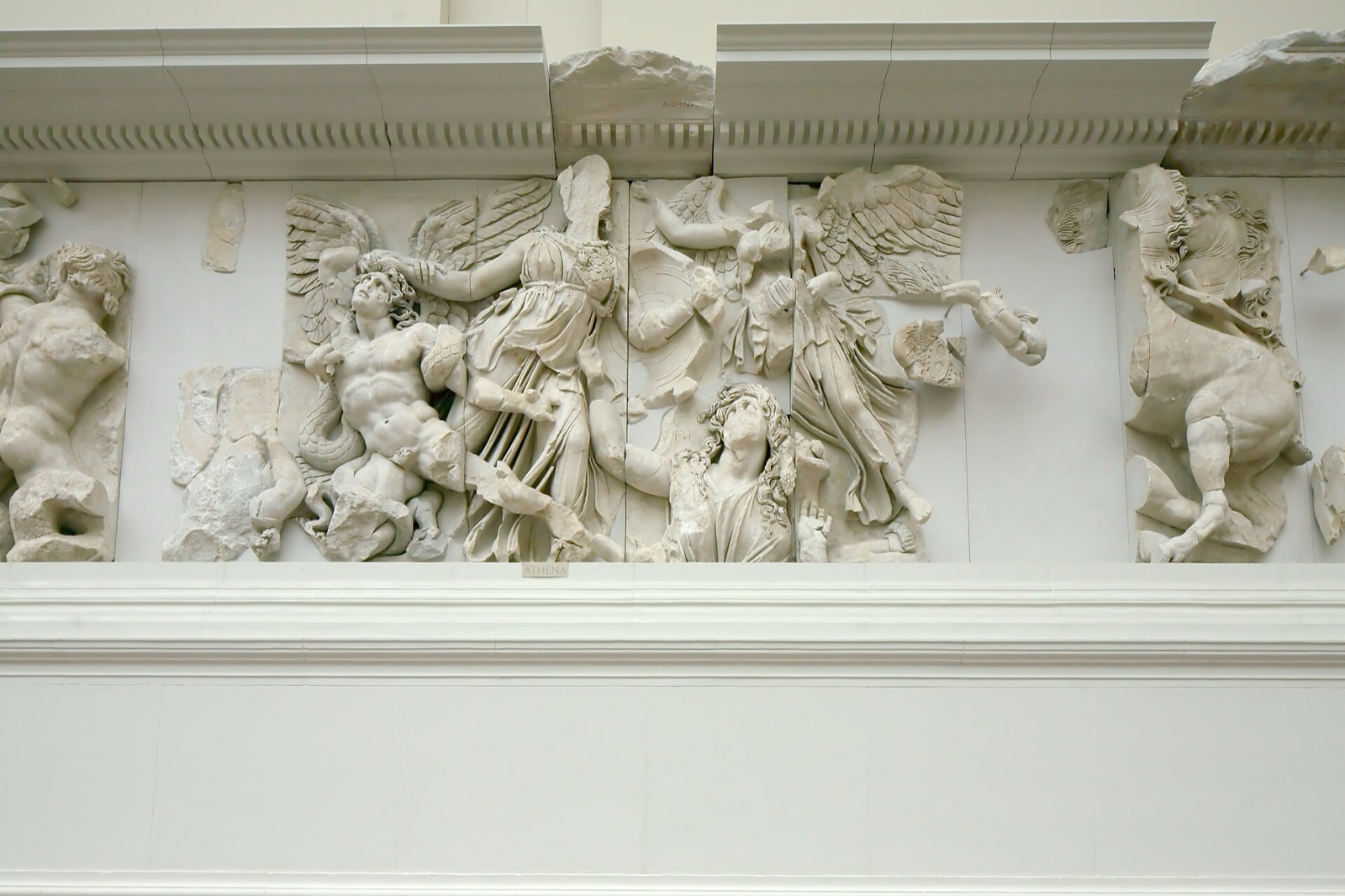
Revelation gives Satan's throne a location: the city of Pergamum
I know your works and where you dwell, where Satan’s throne is. … in the days of Antipas my witness, my faithful one, who was killed among you, where Satan dwells.Revelation 2:13
In the letter to the church at Pergamum — a real city on the west coast of what is now Turkey — Christ tells that congregation he knows where they live: "where Satan's throne is." He names a member of the church, Antipas, who was killed there.
This is the only place in the Bible that gives Satan's seat a geographic location, and the letter treats it as somewhere a person could walk to. Pergamum held several candidates. An enormous altar stood on the acropolis. The city had one of the earliest temples anywhere to the worship of a living Roman emperor. And it held a famous healing sanctuary whose emblem was a serpent coiled on a staff. Readers have argued for each. The letter does not say which is meant.
The date Revelation is usually assigned. The letter describes the city as it stood then.
- Pergamum
- A wealthy Greek city in the Roman province of Asia, near modern Bergama in Turkey. One of the seven churches addressed in Revelation 2 and 3.
- Antipas
- A Christian of Pergamum, named here as having been killed for his faith. Nothing further about him is recorded in the Bible.
Outside the Bible
The altar is the direct evidence for this plate, and it is not a Christian object. Built under King Eumenes II to celebrate Pergamon's victories over invading Gauls, it presents those victories as the gods' war against the Giants — earth-born rebels who attack heaven and lose.
The word the Septuagint translators chose in Alexandria in the third century BC to render the Hebrew Nephilim at Genesis 6:4 was gigantes: these giants. That single decision is why every later Western picture of a giant descends from Greek sculpture like this frieze. The city also held the Asklepieion, a healing sanctuary whose emblem was a serpent on a staff, and a temple to Rome and Augustus built about 29 BC, among the earliest anywhere dedicated to a living emperor.
The Great Altar of Pergamon, Gigantomachy frieze
The monument itself, standing in the city Revelation 2:13 names. It is the structure most often identified with the throne, though the letter does not say so.
- Maker
- Pergamene sculptors, names unrecorded; photograph by MatthiasKabel
- Origin
- Pergamon, near modern Bergama, Turkey, about 165–156 BC
- Held by
- Pergamonmuseum, Berlin
- Licence
- CC BY-SA 3.0 — photograph by MatthiasKabel, attribution required
Made for —
What it shows — The goddess Athena drags the winged giant Alkyoneus upward by the hair while his mother Gaia rises out of the ground toward him, her face already grieving. The carving is cut so deep the figures break out of the frieze and spill onto the stairs, so that anyone climbing the altar walked through the battle. The giants are given serpents in place of legs, and the most human faces on the monument.
XIVSatan in God's court
Still futureundatedRevelation
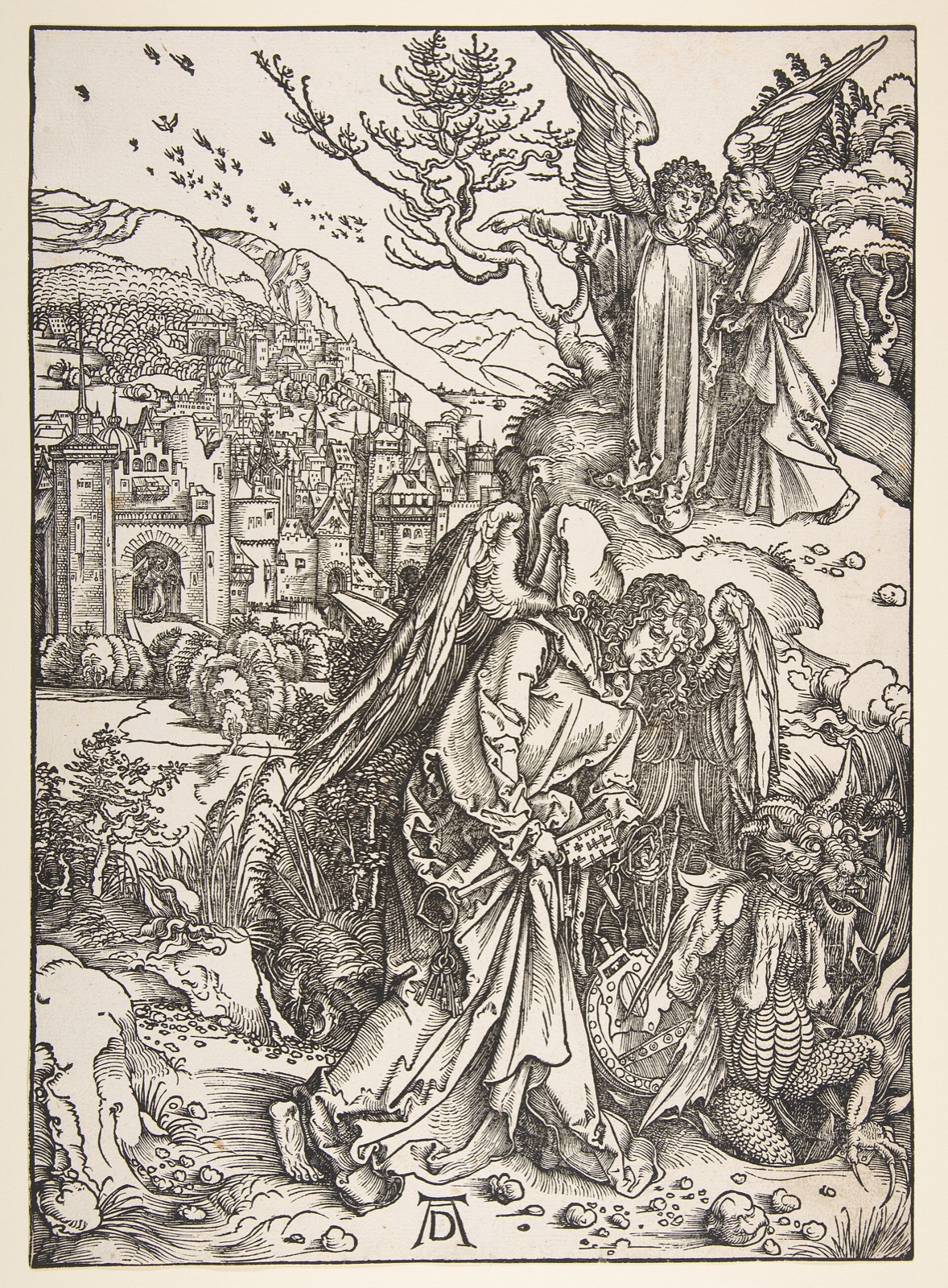
Satan is imprisoned, released, and finally judged
He seized the dragon, the old serpent, which is the devil and Satan … and bound him for a thousand years, and cast him into the abyss … After this, he must be freed for a short time.Revelation 20:2–3
Revelation 20 brings Satan's thread to an end, and it does so in stages rather than in one act. An angel seizes him, binds him, and shuts him in the abyss for a thousand years. When that period ends he is released for a short time. Verse 10 gives the final outcome: he is thrown into the lake of fire.
The two threads of this exhibit finish in the same place but arrive by different routes and on different timetables. The angels of Jude 6 were imprisoned once, before the Flood, and have simply waited since. Satan is sentenced in Eden, keeps his access to God's court through most of the Bible, loses it, is bound, is released, and is judged last of all.
The globe’s final act, which has not happened.
- the abyss
- Greek abyssos, "the bottomless place." In Revelation it is a holding prison, distinct from the lake of fire, which is the final destination.
- a thousand years
- The period described in Revelation 20:2–7. Christians differ over whether it denotes a literal span or a symbolic one; this exhibit takes no position.
Outside the Bible
Binding a defeated adversary underground, rather than destroying it outright, is how the surrounding cultures ended the same story. Hesiod's Theogony has Zeus shut the Titans in Tartarus behind a bronze gate. Persian tradition binds the three-headed dragon Azi Dahaka inside Mount Damavand until the end of the world, when he breaks loose for a final period before being destroyed — the same sequence of imprisonment, release and destruction that Revelation 20 gives.
1 Enoch describes the parallel imprisonment of the angels from the previous plate: the archangel Raphael binds Azazel hand and foot and casts him into darkness at a place called Dudael, and Michael binds Semyaza and the rest for seventy generations. The Aramaic Book of Giants, found among the Dead Sea Scrolls, carried that story onward: Manichaean missionaries took it east, and fragments have been recovered at Turfan in western China, written in Middle Persian, Sogdian and Uyghur.
The Angel with the Key to the Bottomless Pit
Dürer is illustrating Revelation 20:1–3, the passage quoted above.
- Maker
- Albrecht Dürer
- Origin
- Nuremberg, Germany, from The Apocalypse, c. 1496–1498
- Held by
- The Metropolitan Museum of Art, New York
- Licence
- CC0
Made for —
What it shows — The angel holds a heavy key in one hand and a length of chain in the other, and is forcing the dragon head-first down into the mouth of the pit. In the upper half of the same sheet a second angel shows John the new city, measuring it with a rod — so Dürer puts the imprisonment and what follows it in one image. The dragon still has all its heads, and is still fighting.